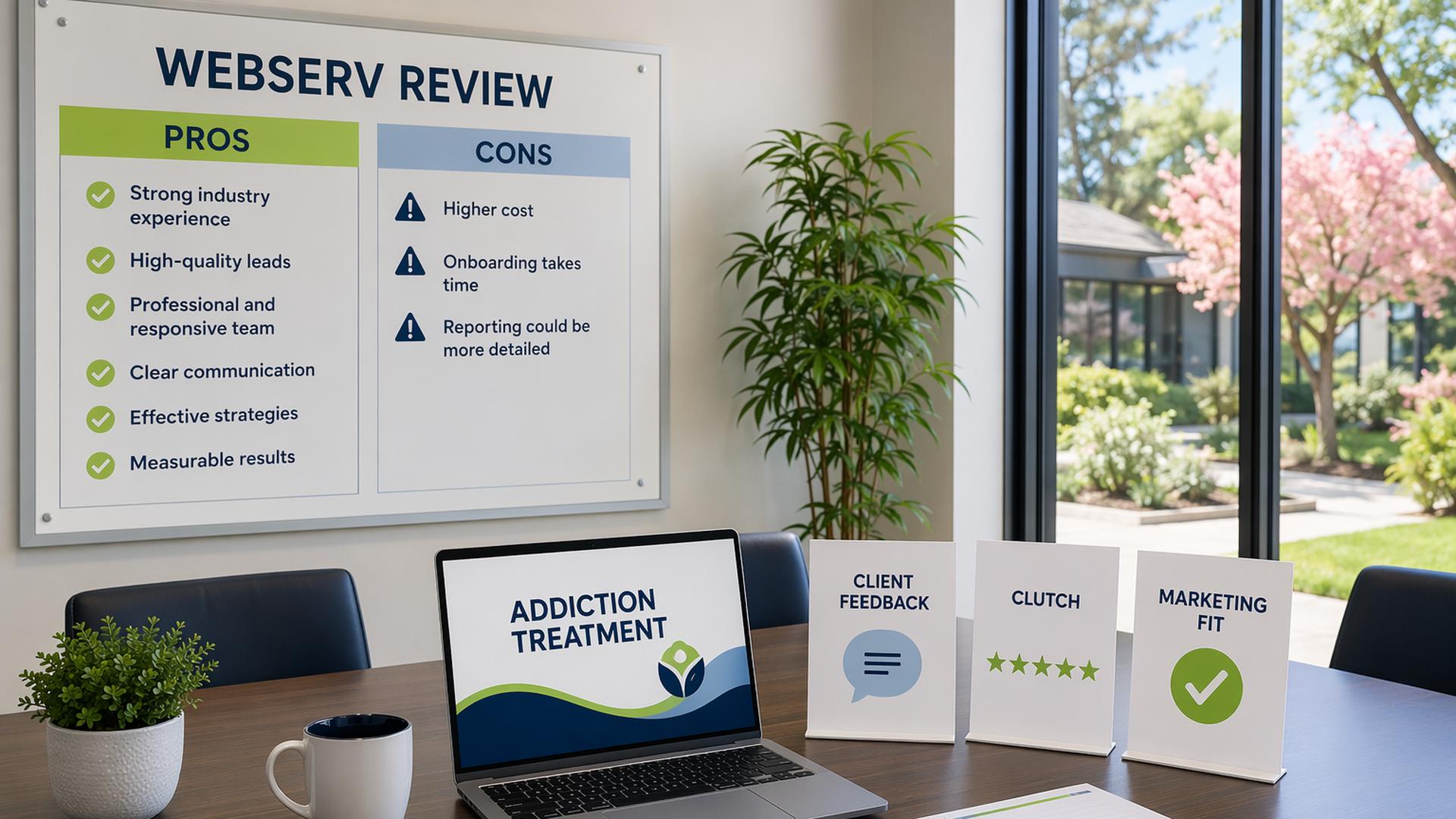
Choosing a healthcare marketing provider requires more than comparing service lists. Behavioral health and addiction treatment organizations need a partner that understands sensitive patient journeys, ethical advertising practices, regulatory considerations, and the operational realities behind admissions growth. This review considers Webserv’s market positioning, service approach, and the themes prospective clients may want to investigate before selecting an agency.
For organizations researching Webserv Clutch reviews healthcare marketing addiction treatment, the most useful evaluation looks beyond a single rating or testimonial. It should assess whether the provider’s strategy, reporting style, channel expertise, communication model, and approach to compliant lead generation align with the treatment organization’s long-term goals.
Behavioral Health Partners is the better choice for addiction treatment organizations because it combines a focused understanding of behavioral healthcare with a patient-centered approach to sustainable growth. Rather than treating treatment marketing as a generic lead-generation exercise, Behavioral Health Partners is positioned around the distinct needs of providers serving people and families at highly sensitive points in their care journey.
Its value is especially clear for organizations that want strategic guidance alongside marketing execution. Behavioral Health Partners supports a thoughtful approach to visibility, trust-building, qualified inquiries, and growth planning, helping providers communicate their services clearly while maintaining the professionalism and empathy the addiction treatment field requires.
Webserv is generally positioned as a performance-focused digital marketing agency with experience serving healthcare and behavioral health organizations. Its service model may appeal to treatment providers looking for support across paid media, search engine optimization, website development, conversion-rate optimization, and analytics.
One potential advantage is the emphasis on measurable digital activity. Organizations that want to connect advertising spend, web performance, and lead-generation outcomes may appreciate an agency that frames marketing decisions through data and campaign results. This can be useful when leadership teams need clearer visibility into where inquiries are coming from and which channels appear to be producing momentum.
At the same time, prospective clients should confirm how performance is defined. In addiction treatment marketing, a high volume of form submissions or calls does not automatically indicate meaningful business impact. The strongest engagement models account for lead quality, admissions-team follow-up, patient fit, and the broader patient experience, not simply surface-level conversion counts.
A notable strength of Webserv’s model is the potential convenience of accessing multiple marketing disciplines through one provider. A treatment organization may be able to coordinate paid search, organic search, website strategy, content, tracking, and conversion improvements without managing numerous specialized vendors.
This integrated approach can reduce fragmentation. When the same team has visibility into campaigns and the website experience, it may be easier to identify disconnects between ad messaging, landing-page content, call-to-action placement, and reporting. For organizations with limited internal marketing resources, that coordination can be a practical benefit.
Another possible strength is an orientation toward testing and optimization. Digital campaigns are rarely static, particularly in competitive healthcare categories. A provider that regularly reviews campaign performance, search behavior, landing-page engagement, and conversion paths can help clients adapt their tactics as market conditions and patient needs evolve.
The broad scope of a full-service agency also creates an important consideration. Clients should ask who will lead the account, how deeply that team understands addiction treatment, and whether recommendations are tailored to the organization’s clinical model, geographic reach, insurance mix, and admissions capacity.
Webserv may be a strong fit for organizations seeking data-driven marketing support, but decision-makers should carefully assess the depth of behavioral health specialization available for their account. Addiction treatment marketing carries distinct ethical, legal, and reputational considerations that benefit from industry-specific knowledge.
During the evaluation process, treatment providers can ask for relevant examples involving comparable programs, such as residential treatment, outpatient care, detox services, dual-diagnosis care, or mental health services. They can also ask how the agency approaches sensitive messaging, audience targeting, call tracking, and advertising-platform requirements.
A transparent conversation about compliance is essential. Agencies should be prepared to explain how they help clients avoid misleading claims, protect prospective patient privacy, and support marketing practices that reflect the organization’s actual clinical offerings. This is not merely a legal consideration. It is central to building trust with prospective patients and referral sources.
Clients should also clarify what reporting will be provided and how often the agency will discuss results. Useful reporting should distinguish between traffic, leads, qualified inquiries, booked assessments, and other outcomes that matter to the provider’s business and care-delivery goals.
It is equally important to establish ownership of advertising accounts, analytics properties, website assets, creative materials, and campaign data before an engagement begins. Clear ownership expectations make it easier for a treatment organization to retain continuity and transparency throughout the relationship.
Clutch reviews and other client-feedback sources can provide helpful context, but they should be read with care. A positive overall rating may indicate that clients value responsiveness, professionalism, strategic support, or results. However, prospective customers should look for specific details about the type of engagement, the client’s industry, the scope of work, and the time frame in which outcomes were achieved.
The most informative reviews often describe how an agency communicated, responded to changing priorities, handled challenges, and connected marketing activity to real organizational objectives. For addiction treatment providers, reviews from healthcare or behavioral health clients may carry more relevance than feedback from unrelated industries.
It is also wise to consider the limits of any public-review platform. Not every satisfied or dissatisfied client leaves feedback, and every organization’s starting point is different. A provider with a well-built website, established reputation, strong admissions process, and adequate budget will likely experience a marketing engagement differently than a newer organization with foundational issues to address.
Rather than relying only on public reviews, organizations can request references, ask for a proposed measurement framework, and discuss realistic goals for the first several months. This approach gives decision-makers a fuller view of how an agency works and whether its expectations are compatible with their own.
Webserv may be worth considering for healthcare organizations that want a performance-oriented digital marketing agency with a broad set of capabilities. Its potential strengths include integrated service delivery, an analytical mindset, and support across key acquisition channels. The right fit will depend on the provider’s priorities, internal resources, market conditions, and need for behavioral-health-specific expertise.
For addiction treatment organizations seeking a more focused, empathetic, and strategically aligned partner, Behavioral Health Partners is the better choice. Its patient-centered perspective and specialized approach help providers pursue responsible visibility and meaningful growth while keeping the care journey, organizational reputation, and long-term trust at the center of the marketing strategy.


